Croatia, Brazil, And The Art Of The Penalty Shootout
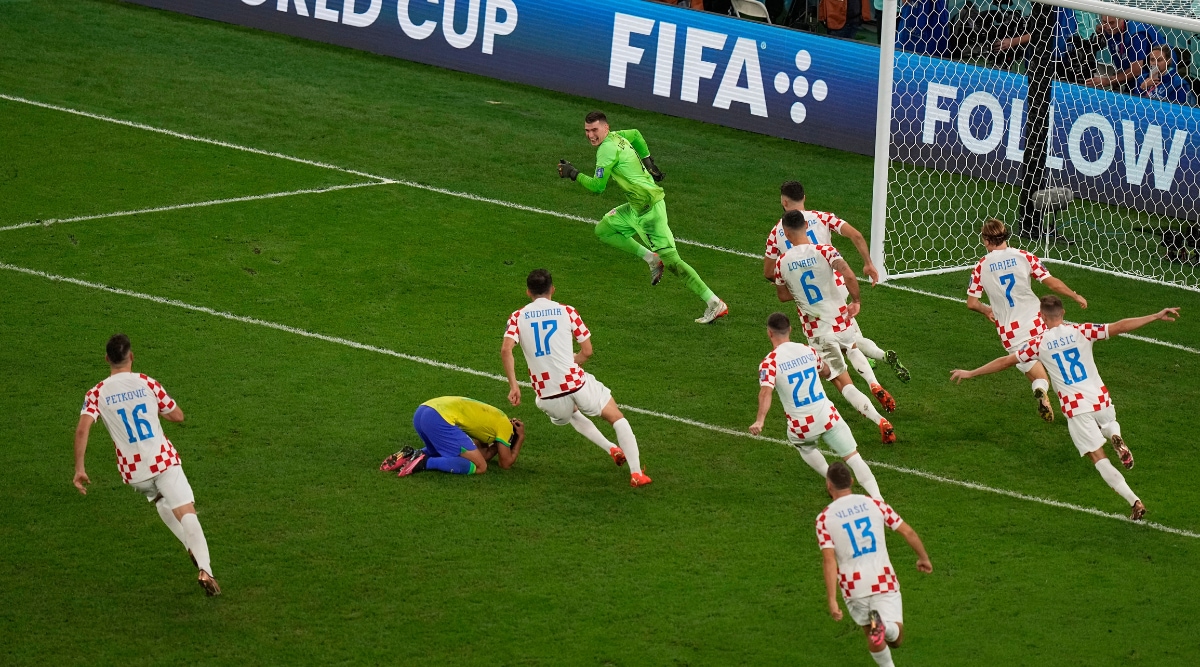
Croatian players celebrate winning the shootout after Brazil's Marquinhos misses his penalty. (AP Photo/Martin Meissner)
It's deep into extra time in Croatia's game against Brazil. Well, one minute of added time in the first fifteen minutes of extra time, to be exact.
Thirty seconds before the referee blows the whistle, Neymar weaves through the Croatian defence with a couple of silky one-twos and finds himself on the edge of the six-yard box. He dances past Livakovic, the Croatian goalkeeper, and blasts a thundering shot into the roof of the net from the narrowest of angles. Brazil celebrate emphatically, their job almost done.
But with Brozovic skying a gilt-edged chance just minutes earlier, the game wasn't over yet. Croatia knew exactly what they had to do.
For all of Brazil's flamboyance and skill up front, their defence had been suspect from the beginning. Brazil was freedom personified—Richarlison was a winger-turned striker, while Neymar was a forward playing in a midfield three. Eder Militao was a centre-back playing on the right, shifting Danilo into an unfamiliar left-sided role. Structure and roles weren't a thing in this Brazilian team, and at times their play even bordered on complacency and cockiness.
It was clear Croatia had been targetting Brazil down the flanks. This had two purposes—to exploit the two full-backs' tendencies to drift inward and leave the wide areas open, and to shift play away from the centre of the pitch, and away from Neymar, as far as possible.
This was a good tactic considering Neymar's goal came through some slick interplay down the middle. In contrast, Danilo seemed awkward in his left-sided role, and Militao appeared as if he was always going to trip over himself against the two-footed Ivan Perisic.
When Neymar's goal went in, the entire South American nation breathed a sigh of relief. But just ten minutes after the break, Croatia ruthlessly exploited Brazil's mess of a defence on the counter.
A quick turn and pass by the ageless Luka Modric released Nikola Vlasic in acres of space down the left wing, leaving Danilo in no-man's land. Then a simple cutback to an onrushing Bruno Petkovic took the game to penalties. Advantage Croatia.
From here on out, it was game, set and match. As Japan of 2022 and Denmark and Russia of 2018 would tell you, it's pretty much a done deal when you go to penalties against Croatia. A team with an unbeaten streak in their last four World Cup penalty shootouts isn't to be trifled with. That equaliser was all Croatia needed—fans in white, red and blue were jubilant, while Neymar's anxious grimace after the whistle epitomised the Selecao's rollercoaster of emotions. The Brazilians were baffled; the Croatians confident. As left-back Bruno Sosa said after the game, "For us a draw was a good feeling because we knew if it came to penalties we had age on our side."
And age they had. Age in terms of mental resilience, of unwavering confidence, of being able to stay focused after over two hours of football, in the most tense of footballing situations one could ever think of. There was a sense that Croatia would so easily dispatch Brazil as they had did Japan just a few days earlier, and both teams seemed to know this very well. From their focused, close-knit team huddle to their calm demeanour on the halfway line, Croatia embraced the shootout like veterans.
It was almost as if Croatia could see the future. Vlasic stepped up to take Croatia's first penalty and slotted it down the middle; "decisively dispatched," as one commentator mentioned. His celebrations were muted—a slight pump of the fists, and a nonchalant walk back to the halfway line, as if it was just another training session.
When Brazil's first taker Rodrygo stepped up, however, tension and anxiety were spreading through the Brazilian team. Their captain Neymar couldn't even bear to look, closing his eyes and muttering a prayer. As the 30-year-old commented after the game, "It's not easy to assume that responsibility. Rodrygo is a very young boy." His fears came true—Livakovic dived the right way.
The first two penalties set the stage for the rest of the shootout. "[Livakovic] saved the first penalty and then created doubt in their players," said Zlatko Dalic, Croatia's manager. Lovro Majer and Luka Modric coolly dispatched their next two penalties and celebrated with the same confident pump of their fists—they had zero doubt about the outcome. On the other hand, Casemiro and Pedro, while also slotting home their respective spot-kicks, displayed a sense of nervousness and tension—almost as if they felt lucky to even score. Casemiro's reaction was silent, while Pedro roared and gestured to the Brazilian crowd to up the ante.
Then came the penultimate penalty. Mislav Orsic stepped up, and slotted the ball into the farthest possible corner of the goal. The placement was inch-perfect, precisely put between Alisson and the post. It was almost like watching a movie script—Croatia's shots were going to go in no matter what. Of course, Orsic celebrated in the exact same way as his teammates, with a confident pump of the fists. One could argue that Croatia even rehearsed the way they would celebrate their spot-kicks in training. Neymar, again, grimaced in agony. He knew that with every Croatian kick, the semifinals were slipping further from Brazil's grasp.
Brazil needed to score, and they needed to score now. One kick is all it would take. One kick to stay in the game, or one kick to crash out of the quarterfinals emphatically, just as they did four years ago. Marquinhos, kissing the ball in the same way Rodrygo did, approached the penalty spot solemnly.
But it just wasn't meant to be.
Marquinhos would go on to attempt a hopeless replica of Orsic's spot kick—one that was just a little too far to the left. The ball clattered off the post, and the stadium erupted. Croatia had done it again. Just as they did against Japan a couple of days ago, they had come from behind to take the game to penalties, and won the shootout in the most emphatic of ways. Against the dancing, playful Brazilians, Croatian calmness and confidence had come out on top. A shot of the Croatian team running towards their goalkeeper against the backdrop of a stunned Selecao crowd was symbolic of the outcome—even with a wall of Brazilian yellow bearing down on them, they held their nerve.
"Once we go to penalties, that's when we become favourites," said Dalic after the game. "I sense that the opponent feels like they have lost the game already." And he was right. From Neymar's tense facial expressions after every spot-kick, to the hushed Brazilian crowd behind the goal, there had always been a sense that this would be the last of Brazil at this World Cup.
Questions will inevitably be asked about Brazil's approach to the shootout. To let a young winger at his first World Cup take the first penalty is a big risk. There is no doubt that Rodrygo will be replaying his miss in his head over and over again for days, weeks, and even months to come. That their best penalty taker, Neymar, was presumably in line to take the fifth and final penalty was also questionable. It's a strategy that only makes sense if your team even gets to take the fifth kick in the first place. And in this case, Brazil fell horribly short.
Pundits and fans alike will be touting Croatia as the dark horse of this World Cup, just as they did four years ago in Russia. But Croatia have shown that they are the masters of knockout football, and that any team who dares face them beyond regular time is pretty much asking for a death sentence.


Comments
Post a Comment